Organic Vs Paid Social Media: A Complete Comparison Guide

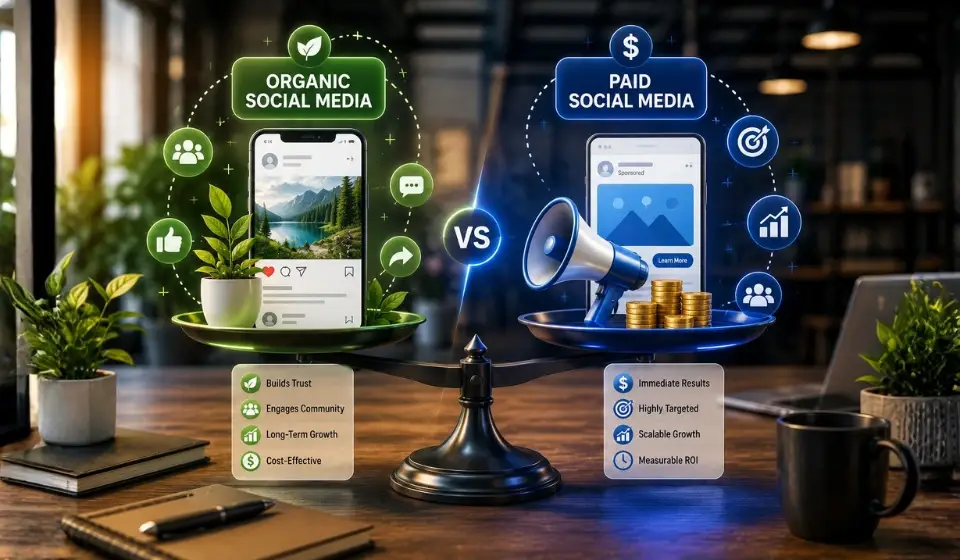
Social media gives businesses two main ways to reach audiences: organic content and paid advertising. Both can increase awareness, engagement, leads, and sales, but they achieve these goals differently. Understanding organic vs paid social media is important when deciding how to allocate marketing time, resources, and budget. Organic activity focuses on building relationships and maintaining a consistent brand presence, while paid campaigns provide greater speed, targeting, and reach. Neither approach is automatically better because the right choice depends on your objectives, audience, budget, and timeline. This guide explains how organic and paid social media work, their strengths and limitations, and how businesses can combine both approaches to create a balanced strategy.
What Is Organic Social Media?
If you are wondering what is organic social media, it refers to content published without paying a platform to distribute it as an advertisement. Businesses use organic activity to communicate with followers, build relationships, and create opportunities for natural discovery.
Success usually depends on consistency, relevant content, creativity, and audience interaction.
Core Elements Of Organic Social Media
Organic social media includes feed posts, Stories, Reels, videos, carousels, polls, educational posts, and other unpaid content. It also includes community management activities such as responding to comments, answering questions, and acknowledging feedback.
Although businesses do not directly pay for organic reach, creating quality content still requires resources. Strategy, copywriting, design, photography, video production, scheduling, and community management all require time or financial investment.
Organic visibility is also influenced by platform algorithms. Content that generates meaningful interactions, shares, watch time, or other positive signals may receive wider distribution.
Businesses therefore need to create content that provides genuine value rather than publishing simply to maintain a posting schedule.
What Organic Social Media Is Best Suited For
Organic social media works particularly well for building a long-term brand presence. Regular useful content helps audiences understand a company’s personality, expertise, products, services, and values.
Educational posts, behind-the-scenes content, customer stories, useful advice, and company updates can gradually strengthen familiarity and trust.
Organic platforms are also useful for maintaining relationships. Businesses can communicate directly with customers, respond to questions, and participate in conversations.
The primary benefit is sustainable relationship building rather than immediate large-scale reach.
What Is Paid Social Media?
Understanding what is paid social media begins with advertising spend. Businesses pay social platforms to distribute sponsored content to selected audiences instead of depending entirely on organic reach.
Paid campaigns provide greater control over audience targeting, budgets, placements, and campaign objectives.
Core Elements Of Paid Social Media
Paid social can include sponsored posts, boosted content, video advertisements, carousel ads, lead generation campaigns, and retargeting.
Platforms typically allow advertisers to target audiences using available signals such as demographics, interests, location, behaviour, previous engagement, or website activity.
Campaigns can be created around objectives such as awareness, website traffic, enquiries, leads, app installations, or sales.
However, spending money does not automatically produce strong results. Performance also depends on targeting, creative quality, campaign structure, competition, offers, and landing page experience.
Paid campaigns therefore require monitoring, testing, and optimisation to use advertising budgets efficiently.
What Paid Social Media Is Best Suited For
Paid social is useful when businesses need faster visibility or want to reach audiences beyond their existing followers.
A new business with a small audience, for example, can use targeted campaigns to introduce its services to potential customers instead of waiting for organic growth.
Paid advertising can also support product launches, promotions, lead generation, ecommerce sales, event registrations, and retargeting.
Its ability to target specific audiences makes paid social particularly valuable when a business has clearly defined goals.
Key Differences Between Organic & Paid Social Media
The difference between organic and paid social media involves more than advertising spend. The approaches differ in reach, speed, control, targeting, predictability, and longevity.
Understanding these differences allows marketers to select the appropriate method for different objectives.
Cost & Investment
Organic social media does not require direct payment for content distribution. Businesses can publish posts and interact with audiences without paying for every impression or click.
However, organic marketing is not completely free. Content planning, graphic design, copywriting, photography, video production, and community management all require resources.
Paid social requires these creative resources plus an advertising budget. Businesses must decide how much they can invest and whether campaign outcomes justify the cost.
When comparing organic marketing vs paid marketing, businesses should therefore evaluate total resources rather than viewing organic activity as free.
Speed & Reach
Organic audience growth generally takes time. Businesses need to publish consistently, test different content, and gradually build engagement.
Algorithms also determine how widely content is distributed, giving businesses limited control over organic reach.
Paid campaigns can generate visibility much faster. Businesses can select audiences and begin reaching potential customers shortly after launching a campaign.
However, paid visibility depends heavily on continued advertising investment. Once campaigns end, their ability to generate new impressions usually declines quickly.
Pros & Cons Of Each Approach
When comparing organic social media vs paid social media, neither method performs best in every situation. Each offers specific advantages while presenting limitations that marketers should understand.
Advantages & Limitations Of Organic Social Media
Organic content can build authentic relationships and strengthen brand credibility. Businesses can demonstrate expertise, share their personality, educate customers, and encourage conversations without paying for each interaction.
Organic engagement also provides useful audience insights. Comments, questions, shares, and reactions can reveal what topics people find valuable.
However, organic reach can be unpredictable. Platform algorithms and increasing competition mean even accounts with many followers cannot guarantee that every post will receive significant visibility.
Building a meaningful audience can also take considerable time and consistent effort.
Advantages & Limitations Of Paid Social Media
Paid advertising offers speed, targeting, scalability, and measurable control. Businesses can define an audience, establish a budget, test multiple creatives, and track performance against specific objectives.
It can also reach potential customers who have never interacted with the brand before.
The main limitation is its dependence on budget. When advertising stops, paid visibility generally stops as well.
Poor targeting or ineffective creative can also consume budgets quickly. Businesses need ongoing testing and optimisation to maintain efficient performance.
How To Build An Effective Strategy Combining Both
The organic vs paid social media marketing comparison should not necessarily result in choosing only one approach. The two can support each other when they are connected to common marketing objectives.
Organic content can establish credibility, while paid campaigns can amplify successful messages and reach new audiences.
Using Organic Content To Build Trust & Community
Businesses should develop a useful organic presence that gives potential customers a reason to follow, interact, and return.
Educational content, customer experiences, behind-the-scenes posts, helpful tips, and company updates can demonstrate expertise while making the brand more relatable.
Organic engagement can also reveal audience preferences. Posts that generate strong shares, comments, saves, or watch time can provide useful insights into topics and formats worth developing further.
This creates a stronger foundation before increasing investment in advertising.
Using Paid Campaigns To Amplify What Works
Businesses can use paid advertising to expand the reach of organic content that has already demonstrated strong audience interest.
Rather than promoting every post, identify content with strong engagement and determine whether its message aligns with a commercial objective.
Paid campaigns can then target specific goals such as awareness, lead generation, website traffic, retargeting, or sales.
Data from paid campaigns can also improve organic strategy by revealing which audiences, messages, and creative approaches generate meaningful action.
When both approaches share insights, social media becomes a continuous process of testing, learning, and improvement.
Key Takeaways
Organic and paid social media serve different but complementary purposes. Organic activity helps businesses develop trust, community, relationships, and a consistent brand presence, while paid social provides faster reach, targeted distribution, and greater campaign control. Organic growth can be slower and less predictable, while paid visibility depends on continued investment. Businesses should therefore avoid treating the two approaches as competitors. Build an organic foundation that provides genuine value, then use paid campaigns strategically to amplify successful content and reach relevant new audiences. Combining long-term relationship building with targeted advertising creates a more balanced social media strategy that can support both immediate marketing objectives and sustainable brand growth.
Latest Post
Reasons Why Your Website Isn’t Ranking On Google
Reasons Why Your Google Ads Aren’t Converting

Technical SEO Mistakes To Watch Out For
Common Social Media Marketing Mistakes

Website Security Best Practices Every Business Should Follow
Organic Vs Paid Social Media: A Complete Comparison Guide
On-Page SEO Vs Off-Page SEO: What’s The Difference

The Importance Of E-E-A-T In Modern SEO
SEO Checklist For New Websites In 2026
Social Media Trends Businesses Should Follow
How To Optimize For AI Search & Rank Higher In Google AI Overviews