Reasons Why Your Website Isn’t Ranking On Google

Ranking on page one means little if your website never shows up in search results in the first place. For many businesses, poor visibility is rarely caused by one isolated problem. Crawling restrictions, weak content, incorrect keyword targeting, technical problems and limited website authority can overlap and make it difficult for search engines to understand or trust a site. When a website is not ranking on Google, identifying the actual cause requires looking beyond individual keywords and assessing the broader SEO picture. Understanding the most important Google ranking factors can help you identify what is holding your website back and where improvements are likely to have the greatest impact.
Common Reasons Your Website Isn't Ranking On Google
Search rankings depend on numerous signals related to accessibility, relevance, quality, authority and user experience. A website may perform well in one area while weaknesses elsewhere continue to restrict its visibility. The following are some of the most common causes of Google ranking issues and the areas businesses should investigate when organic performance falls short.
Your Website Has Crawling Or Indexing Issues
Before Google can rank a page, it needs to discover, crawl and index it. If search engine crawlers cannot access important pages, even excellent content and strong optimisation will have limited impact.
Common problems include accidentally blocking important URLs through the robots.txt file, applying noindex directives to pages that should appear in search, submitting an incorrect XML sitemap or creating internal links that lead to broken pages.
Google Search Console should be one of the first places to investigate these issues. Its indexing and crawling reports can help identify pages Google cannot access, URLs that have been excluded and other technical problems affecting visibility.
Businesses should also ensure their XML sitemap contains relevant, indexable URLs and that important pages can be reached through logical internal navigation. Fixing accessibility problems establishes the foundation required for every other SEO activity.
Your Content Does Not Match Search Intent
Using the right keyword does not automatically make a page relevant. Google increasingly focuses on understanding what searchers expect to find when they enter a particular query.
Search intent generally falls into categories such as informational, navigational, commercial and transactional. Someone searching for a guide is likely expecting educational content, while someone searching for a specific service may expect a commercial landing page.
If your content format does not align with that expectation, ranking becomes more difficult even when the keyword appears throughout the page.
Reviewing current top ranking pages can provide useful clues about intent. Look at whether Google is favouring guides, service pages, product listings, comparisons or another format. Rather than copying competitors, use these patterns to understand what information searchers expect and create a resource that addresses their needs more effectively.
Your Website Targets The Wrong Or Overly Competitive Keywords
Keyword selection plays a major role in organic search ranking potential. A relatively new or low authority website may struggle to compete for broad keywords dominated by established brands and authoritative publications.
Businesses often focus heavily on high search volume terms while overlooking more specific opportunities. Long tail keywords typically attract lower search volumes individually, but they can have clearer intent and less competition.
Keyword difficulty should therefore be considered alongside relevance, search intent and website authority. Targeting achievable terms can help a website gradually establish topical relevance and attract qualified traffic before competing for more difficult searches.
A balanced strategy generally includes a mixture of broader long term targets and more specific keywords capable of generating earlier visibility.
Your Content Lacks Quality, Relevance & Topical Depth
Thin content is another common reason websites struggle to rank. Publishing a short page that briefly mentions a keyword without answering the searcher’s broader questions rarely provides enough value in competitive search results.
Quality content should explore a subject with appropriate depth while remaining useful and easy to understand. That might involve addressing related questions, explaining important concepts, including practical examples and covering relevant subtopics.
Competitor analysis can help identify information that existing ranking pages commonly address. However, the objective should not be to make content longer simply because competitors have lengthy pages. Depth should come from usefulness.
Google’s systems aim to surface helpful, reliable content created for people. Demonstrating genuine subject knowledge and providing meaningful information therefore matters more than producing generic text designed primarily around keywords.
Your On-Page SEO Is Not Properly Optimised
Strong content still needs clear signals that help search engines understand its topic and structure. On-page optimisation ensures those signals are present without compromising readability.
Title tags should accurately describe each page while naturally incorporating its primary topic. Meta descriptions can improve how search listings communicate relevance to potential visitors, although they are not a direct ranking factor.
Heading structures should organise information logically, while important keywords and related concepts should appear naturally in relevant sections. Internal links are equally valuable because they help users and search engines discover related pages while establishing relationships between topics.
Other details, including descriptive image alt text and clear URL structures, are frequently overlooked. Individually these elements may seem minor, but together they create stronger contextual signals and improve overall page accessibility.
Your Website Has Technical SEO Issues
Technical problems can limit performance even when content and keyword targeting are strong. Search engines need websites that can be efficiently crawled, understood and served to users across devices.
Slow page loading, broken links and mobile usability problems can create barriers for visitors and search engines. Duplicate pages may also create uncertainty about which version should appear in search results, particularly when canonical tags are missing or implemented incorrectly.
Structured data can provide additional context about certain types of website content and enable eligibility for supported search features. Incorrect schema markup, however, may prevent those enhancements from appearing.
A comprehensive technical SEO audit can uncover these problems and help prioritise fixes according to their likely impact. Technical health should be monitored regularly rather than treated as a one time optimisation task.
Your Website Lacks Quality Backlinks & Authority
Backlinks remain an important part of Google’s systems for understanding authority and discovering useful resources across the web. When reputable and relevant websites link to a page, those links can provide signals about its credibility and importance.
A website with very few authoritative backlinks may struggle against competitors with established link profiles, even when its content is comparable or better.
Quality matters significantly more than simply accumulating links. Large numbers of irrelevant or manipulative backlinks can provide little value and may create additional risks.
Businesses can earn meaningful links through original research, useful resources, digital PR, industry partnerships and genuine outreach. Creating content that other websites have a reason to reference is generally more sustainable than pursuing links purely for SEO purposes.
Authority develops gradually, so backlink acquisition should be viewed as a long term component of SEO rather than a quick ranking fix.
Poor User Experience & Website Performance Are Holding You Back
SEO does not end when someone clicks a search result. The experience visitors have after arriving on the website matters to both conversions and overall search performance.
Slow loading pages, confusing navigation, intrusive pop-ups and poorly designed mobile experiences can cause visitors to leave quickly. These problems can also prevent users from finding the information or completing the action they originally came for.
Google’s Core Web Vitals assess aspects of real world page experience, including loading performance, responsiveness and visual stability. Core Web Vitals are part of Google’s page experience considerations, although they should be viewed alongside many other SEO ranking factors rather than as a standalone route to higher rankings.
Improving usability, mobile responsiveness and page performance creates a better experience for visitors while supporting the broader technical quality of the website. Ultimately, many Google organic ranking factors work together, so user experience should complement strong content, technical SEO and authority building.
Key Takeaways
Poor search visibility is rarely caused by a single mistake. Crawling and indexing problems, mismatched search intent, unrealistic keyword targeting, weak content, incomplete on-page optimisation, technical issues, limited backlinks and poor user experience can all contribute to lower rankings. Effective SEO requires these areas to work together rather than treating each one in isolation. Businesses experiencing ranking difficulties should audit their website against each of these factors, prioritise the most significant problems and continuously monitor performance as improvements are implemented.
Latest Post
Reasons Why Your Website Isn’t Ranking On Google

Reasons Why Your Google Ads Aren’t Converting
Technical SEO Mistakes To Watch Out For
Common Social Media Marketing Mistakes

Website Security Best Practices Every Business Should Follow

Organic Vs Paid Social Media: A Complete Comparison Guide
On-Page SEO Vs Off-Page SEO: What’s The Difference

The Importance Of E-E-A-T In Modern SEO
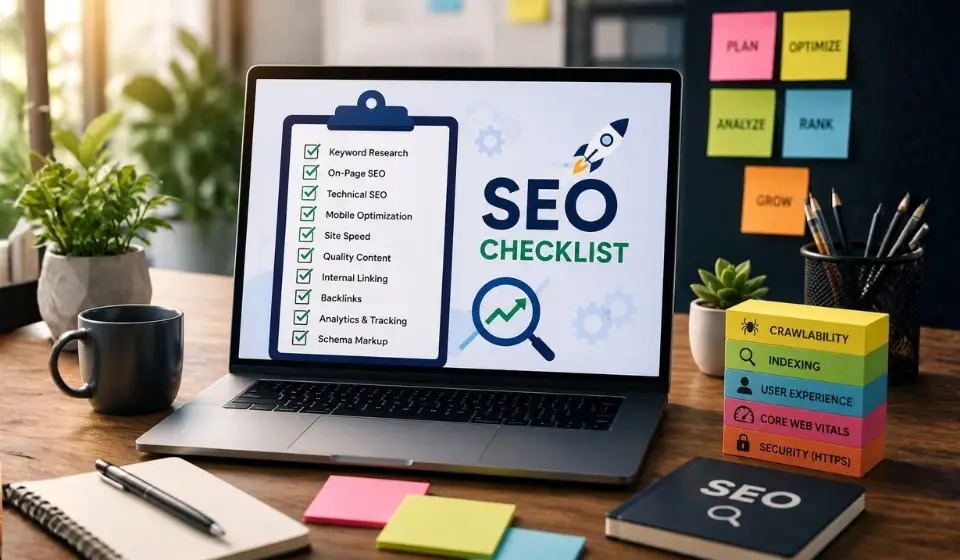
SEO Checklist For New Websites In 2026

Social Media Trends Businesses Should Follow
How To Optimize For AI Search & Rank Higher In Google AI Overviews