Common Social Media Marketing Mistakes

Even a great product or service can struggle to gain traction when its social media presence is poorly executed. Businesses today have access to powerful platforms for building awareness, connecting with customers and generating leads, yet simply posting regularly does not guarantee meaningful results. Many brands unknowingly make social media marketing mistakes that limit their reach, weaken engagement and prevent followers from becoming customers. From targeting the wrong audience to ignoring performance data, seemingly small decisions can have a significant cumulative impact. Understanding these mistakes can help businesses identify what is holding their social presence back and develop a more strategic approach to achieving measurable marketing outcomes.
Common Social Media Marketing Mistakes
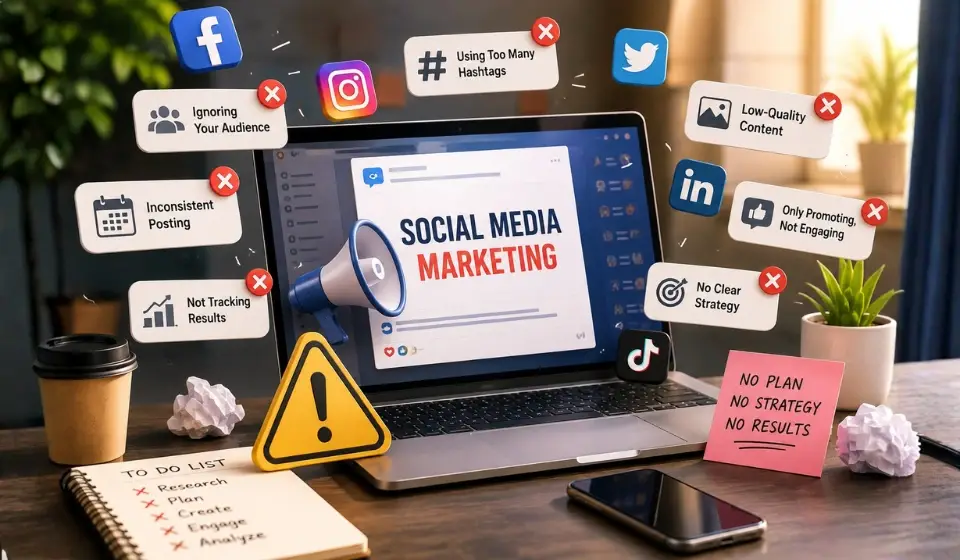
Effective social media marketing requires more than attractive graphics and occasional posts. Every piece of content should have a purpose, address the right audience and contribute to broader marketing objectives. However, businesses often fall into habits that create activity without generating meaningful progress. Recognising the following common social media mistakes is an important first step towards building a stronger and more sustainable presence.
Not Having A Clear Social Media Strategy
Posting without a defined strategy is one of the easiest ways to waste time and marketing resources. A business may publish content several times each week, but if there is no clear objective behind those posts, measuring success becomes difficult.
Every social media strategy should define what the business wants to accomplish. Goals might include increasing brand awareness, generating enquiries, driving website traffic, strengthening customer relationships or supporting sales.
These objectives should also connect with the organisation’s wider business and marketing goals. A clear content roadmap then determines what topics, formats and campaigns will help achieve them. Without this direction, messaging can become inconsistent and teams may spend considerable effort creating content that contributes little to actual business growth.
Targeting The Wrong Audience
Strong content is only valuable when it reaches people who are genuinely interested in what the business offers. Creating posts without understanding the ideal customer often results in low engagement, irrelevant followers and poor conversion rates.
Audience research should consider demographics, interests, online behaviour, needs and common problems. Developing buyer personas can help businesses visualise exactly who they are communicating with and what matters to those people.
This understanding should influence everything from content topics and tone of voice to platform selection and advertising targeting. Rather than trying to appeal to everyone, brands can create more relevant content for audiences that are more likely to engage and eventually convert.
Posting Inconsistently Or Without A Content Plan
Publishing several posts one week and disappearing for the next two can make it difficult to maintain audience attention. Irregular activity may also reduce opportunities for engagement and visibility within platform feeds.
A content calendar provides structure by planning topics, formats and publishing dates in advance. It reduces last minute content creation, which often results in rushed messaging, repetitive ideas or lower quality posts.
Consistency does not necessarily mean posting every day. The right frequency depends on the platform, available resources and audience behaviour. What matters is establishing a realistic schedule that the business can maintain while preserving content quality. A predictable presence can help build audience familiarity and provide platforms with consistent engagement signals.
Focusing Too Much On Promotional Content
Social media users generally do not follow brands simply to see advertisements. If every post promotes a product, discount or service, audiences can quickly lose interest.
A useful principle is the 80/20 approach, where the majority of content provides value while a smaller proportion focuses directly on promotion. This does not need to be followed as an exact formula, but it encourages businesses to think beyond constant selling.
Educational tips, industry insights, useful guides, customer stories, entertaining posts and behind the scenes content can all provide reasons for people to continue following a brand. Promotional messages can then be introduced naturally within a broader content mix.
The objective is to create a relationship before repeatedly asking the audience to purchase something.
Ignoring Audience Engagement & Community Management
Social media is designed for conversation, yet some businesses still treat it as a one way broadcasting channel. Publishing content without responding to comments, messages or mentions can create distance between a brand and its audience.
When someone comments on a post or asks a question, they are creating an opportunity for direct interaction. Timely and thoughtful responses can demonstrate that the business values its community and takes customer communication seriously.
Engagement can also contribute to visibility. Likes, comments, shares, saves and meaningful interactions provide platforms with signals that users find content relevant.
Community management should therefore be treated as an active part of social media strategy rather than something that happens only when time allows. Building genuine relationships can strengthen loyalty while helping brands better understand their customers.
Using The Same Content Across Every Social Media Platform
Copying one post and publishing it unchanged across every platform may save time, but it often sacrifices performance. Each social network has its own audience behaviour, content formats and communication style.
A detailed LinkedIn post, for example, may need to be adapted into a visual carousel or short video for another platform. The underlying message can remain consistent while its presentation changes to suit how people consume content on each channel.
Businesses should consider which formats perform naturally within each platform, including short form videos, images, carousels, stories or text based posts.
Content can certainly be repurposed to improve efficiency. However, repurposing should involve adapting an idea rather than simply copying and pasting it. Platform specific execution helps content feel more natural and increases its chances of generating meaningful engagement.
Overlooking Analytics & Performance Metrics
One of the biggest mistakes in social media marketing is making decisions entirely based on assumptions. A post may look impressive internally but perform poorly with the actual audience.
Social media analytics provide valuable information about what is working. Businesses can review engagement rates, reach, impressions, clicks, conversions, audience demographics and other metrics relevant to their objectives.
Performance data can also reveal practical insights such as which content formats receive the strongest response, when audiences are most active and which topics consistently generate interaction.
Metrics should not simply be collected for monthly reports. They should influence future decisions. If educational videos consistently outperform static promotional graphics, for example, the content strategy should reflect that behaviour.
Using data to guide ongoing optimisation helps businesses address social media marketing problems based on evidence rather than guesswork.
Failing To Adapt To Platform Trends & Algorithm Changes
Social media platforms change constantly. Content formats that generated strong organic reach two years ago may no longer produce the same results today.
The rise of Reels, short form videos, interactive content and creator led formats demonstrates how quickly user preferences can shift. Businesses that continue relying exclusively on outdated approaches may gradually lose visibility even when the quality of their messaging remains strong.
Algorithms also evolve as platforms change how they prioritise content. Factors such as engagement, watch time, relevance and originality can influence what appears in users’ feeds.
Businesses do not need to follow every trend simply because it is popular. Instead, they should monitor changes and determine which developments are relevant to their audience and brand.
Adaptability is one of the major social media marketing challenges businesses must manage. Regular experimentation with new formats, followed by careful performance analysis, allows brands to evolve without abandoning their identity or strategic objectives.
Key Takeaways
Many of the most damaging social media mistakes are also highly avoidable. Posting without a strategy, targeting the wrong audience, being inconsistent, overpromoting, neglecting engagement, duplicating content across platforms, ignoring analytics and failing to adapt can all restrict performance. Sustainable results come from combining clear strategy with consistent execution, audience understanding, meaningful engagement and ongoing optimisation. Businesses should regularly audit their current social media practices against these areas and identify where improvements can be made. Social media success rarely comes from simply doing more. It comes from understanding what works, learning from performance and making better decisions over time.
Latest Post

Reasons Why Your Website Isn’t Ranking On Google

Reasons Why Your Google Ads Aren’t Converting

Technical SEO Mistakes To Watch Out For
Common Social Media Marketing Mistakes

Website Security Best Practices Every Business Should Follow

Organic Vs Paid Social Media: A Complete Comparison Guide

On-Page SEO Vs Off-Page SEO: What’s The Difference

The Importance Of E-E-A-T In Modern SEO

SEO Checklist For New Websites In 2026

Social Media Trends Businesses Should Follow

How To Optimize For AI Search & Rank Higher In Google AI Overviews